Choose from our wide range of
frames and lenses













Back to the articles
Pupillary Distance (PD): What It Is, Normal Values, and How to Measure It Accurately
Guides & How to

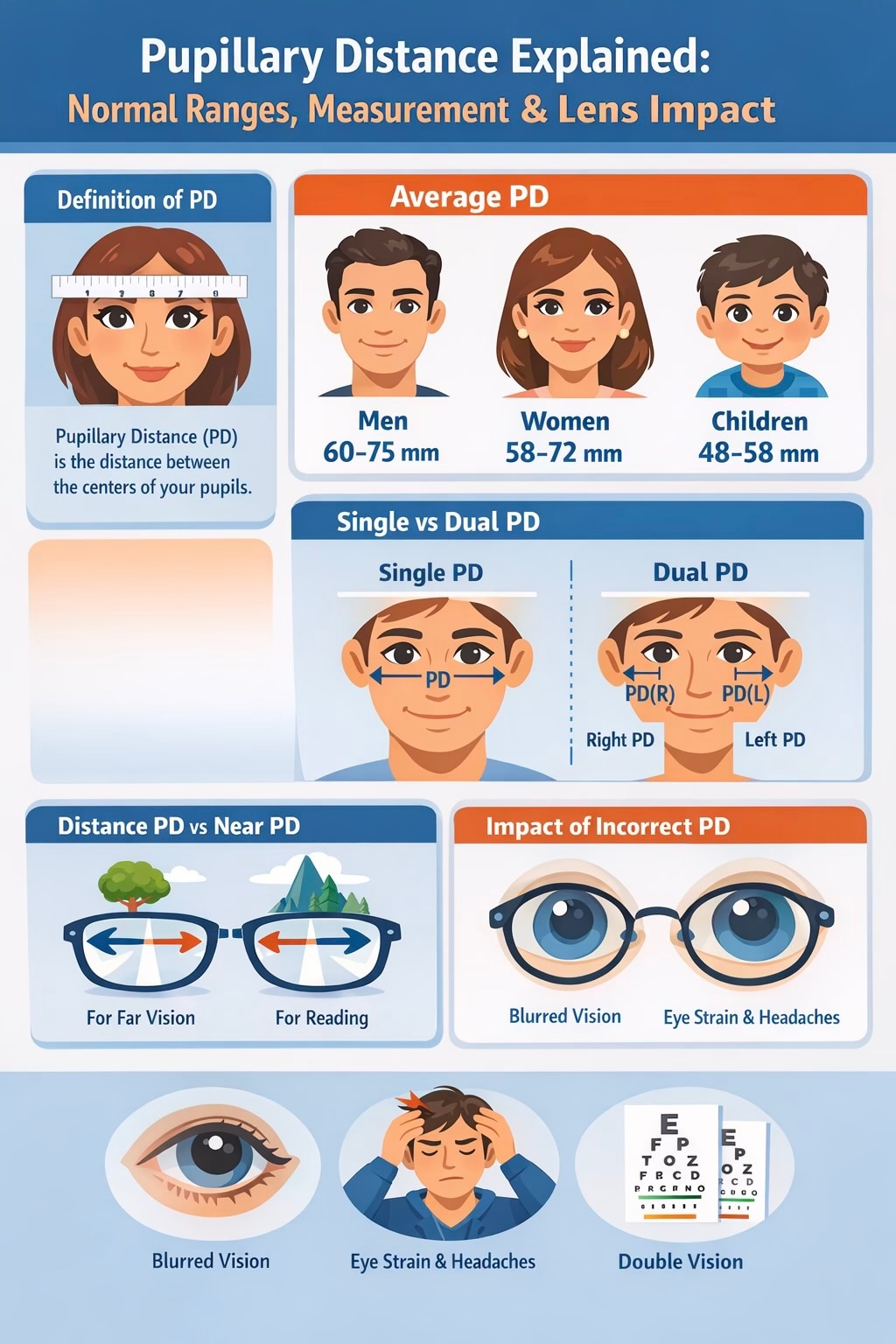
Pupillary distance (PD) is the measurement in millimeters between the centers of your pupils. It ensures lenses are aligned correctly with your eyes, improving visual clarity and comfort in prescription glasses.
What Is Pupillary Distance?
Pupillary distance, often abbreviated as PD distance or pupil distance, is a standard measurement used in eyewear prescriptions. It determines where you look through your lenses and directly affects visual accuracy, eye strain, and comfort.
If your pupillary distance is incorrect, even a perfectly written prescription can result in blurred vision or headaches.
Why Pupillary Distance Matters for Glasses
Your PD ensures that the optical center of each lens aligns with your pupils.
Incorrect PD may cause:
- Visual distortion
- Eye fatigue
- Headaches
- Difficulty focusing, especially with multifocal lenses
This is particularly important for progressive lenses, bifocals, and reading glasses, where precision is critical.
What Is a Normal Pupillary Distance?
Average Pupillary Distance for Adults
The normal pupillary distance for adults typically falls within this range:
| Group | Average PD Range (mm) |
|---|---|
| Adult women | 60–65 mm |
| Adult men | 62–67 mm |
| Adults overall | 54–74 mm |
These values explain why searches for average pupillary distance, what is the average pupillary distance, and pupillary distance average often overlap.
Average Pupillary Distance for Children
Children usually have a smaller pupil distance due to facial development.
| Age Group | Average PD Range (mm) |
|---|---|
| Children | 43–58 mm |
Does Pupillary Distance Change Over Time?
Yes, pupillary distance changes during childhood and adolescence as the face develops.
- Children and teens: PD changes gradually.
- Adults: PD remains stable once facial growth stops.
In adults, PD rarely changes unless affected by trauma or medical conditions.
You may also like
How to Measure Pupillary Distance at Home
If your PD is not listed on your prescription, you can measure it yourself.
How to Measure PD with a Ruler
Steps:
- Stand about 8 inches from a mirror.
- Hold a millimeter ruler against your brow.
- Close your right eye and align the zero mark with the center of your left pupil.
- Switch eyes and read the measurement at your right pupil.
- Repeat 3–4 times for accuracy.
This method works well for single PD measurements.
Single PD vs Dual PD (Monocular PD)
What Is Single PD?
Single PD measures the distance between the centers of both pupils. It is commonly used for:
- Distance glasses
- Sunglasses
- Standard prescription lenses
What Is Dual PD?
Dual PD, also called monocular PD, measures each eye separately.
Exmples: 32/30
- First number: right eye (OD)
- Second number: left eye (OS)
Dual PD is especially important for:
- Progressive lenses
- Multifocal prescriptions
- High-precision eyewear
Near PD vs Distance PD for Glasses
The PD used for reading glasses differs slightly from distance PD.
How to calculate near PD
- From single PD: subtract 3 mm.
- From dual PD: subtract 1.5 mm per eye.
This adjustment ensures optimal focus at close reading distances.
Practical Tips for Getting the Most Accurate PD
- Always measure PD in millimeters.
- Take multiple measurements and average them.
- Use professional measurement for progressive or multifocal lenses.
- Recheck PD if ordering glasses online for the first time.
Frequently Asked Questions About Pupillary Distance
What is the average pupillary distance for women?
The average PD for women typically ranges between 60 and 65 mm, though individual facial structure can cause variation.
Is pupillary distance the same as pupil distance?
Yes. Pupillary distance and pupil distance refer to the same measurement and are used interchangeably.
Can I order glasses online without my PD?
Most online retailers require PD for accurate lens alignment. Measuring it at home is acceptable, but professional measurement is recommended for complex prescriptions.
Suggestions for you:
Sources and Authority Signals
Data references adapted from:
- American Optometric Association (AOA)
- Vision Council of America
- Peer-reviewed optometry literature on lens centration and PD accuracy