Choose from our wide range of
frames and lenses


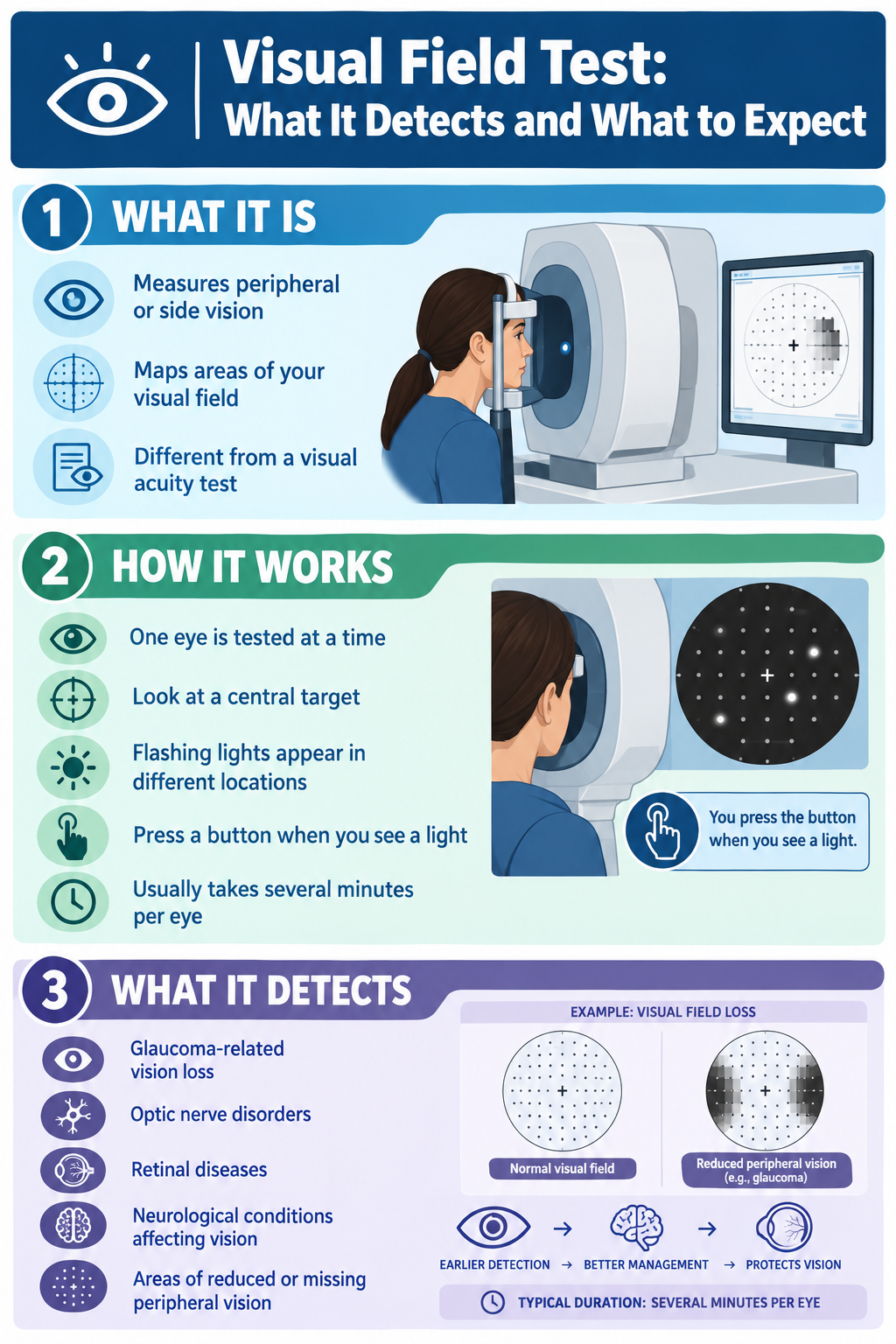
A visual field test maps the full range of your peripheral vision. It can help detect vision loss linked to glaucoma, optic nerve disorders, retinal disease, and other conditions affecting the visual system.
Editorial Review Note: This article was reviewed for medical accuracy and updated to clearly distinguish visual field testing from visual acuity testing.
What Is a Visual Field Test?
A visual field test measures how well you can see objects outside your direct line of sight. This is also called your peripheral or side vision.
Unlike a standard eye chart, which measures visual acuity, a visual field test checks how much of your surrounding visual area you can see.
The test is often used when an eye doctor needs to check for areas of missing or reduced vision. It can be especially useful for detecting and monitoring changes associated with glaucoma and other conditions that affect the optic nerve, retina, or visual pathways.
What Does a Visual Field Test Detect?
A visual field test can help identify patterns of vision loss associated with several eye and neurological conditions.
It may be used to detect or monitor:
- Glaucoma-related peripheral vision loss
- Optic nerve disorders
- Retinal diseases
- Neurological conditions that affect vision
- Areas of reduced or missing peripheral vision
- Changes in vision caused by certain medications or other health conditions
A visual field test measures visual function. It does not directly show physical damage to the retina or optic nerve, and an abnormal result does not automatically mean you have a specific disease.
Your eye doctor may combine the results with other tests, such as an eye pressure measurement, retinal examination, or imaging, to determine what may be causing the change.
What Can an Abnormal Visual Field Mean?
An abnormal visual field can have different causes.
For example, glaucoma may gradually damage the optic nerve and cause loss of peripheral vision. Other changes may be linked to retinal disease, optic nerve problems, neurological conditions, or even difficulty performing the test.
Because visual field results can vary, an eye doctor may repeat the test or compare the results with previous tests before determining whether a meaningful change has occurred.
You may also like
How Does a Visual Field Test Work?
The most common type of visual field test is automated perimetry.
During the test, you usually sit in front of a machine and look at a central target. Small lights appear at different locations within your field of vision.
Each time you see a light, you press a button.
The machine records which lights you can see and which you cannot. It then creates a map of your visual field.
The test is normally performed one eye at a time. Keeping your gaze on the central target is important because looking around can affect the results.
What Is a Confrontation Visual Field Test?
A confrontation visual field test is a simpler way to check peripheral vision.
During this type of test, your eye doctor may ask you to cover one eye and look at a fixed point while they move a hand or object into different areas of your peripheral vision.
It is useful as a quick screening method, but it is less detailed than automated perimetry.
How Long Does a Visual Field Test Take?
A visual field test commonly takes several minutes per eye, depending on the type of test and the equipment being used.
Automated tests can take around 4–7 minutes per eye, although the exact time varies.
A full eye appointment may take longer because your eye doctor may perform additional tests before or after the visual field examination.
If you're wondering how long does a visual field test take, the best answer is: usually several minutes for each eye, but your total appointment can be longer.
Is a Visual Field Test Painful?
No. A visual field test is generally painless and does not require anything to touch your eye.
You simply look at a central point and respond when you notice a light.
The test can feel repetitive or tiring because you need to maintain your focus. If you become tired, tell your eye doctor or technician.
How Can You Prepare for a Visual Field Test?
In most cases, you do not need special preparation.
Before the test:
- Wear your usual glasses if instructed.
- Tell the technician if you have difficulty seeing the test target.
- Keep your head positioned as instructed.
- Focus on the central target.
- Press the response button whenever you see a light.
- Try to stay alert throughout the test.
If you wear eyeglasses, your eye-care professional will tell you whether to keep them on or remove them for the specific test.
What Is a Visual Field Test at the DMV?
A visual field test at the DMV may be used in some situations to evaluate peripheral vision as part of a driver's vision screening or medical review.
However, DMV vision requirements vary by state. A DMV screening is not necessarily the same as the detailed automated visual field testing performed in an eye doctor's office.
If you are preparing for a driver's license vision screening, see our DMV vision test guide for more information about what to expect.
How Is a Visual Field Test Different From a Snellen Eye Chart?
A visual field test and a Snellen eye chart measure different aspects of vision.
Test
What It Measures
Common Use
Visual field test
Peripheral and surrounding vision
Identifying areas of missing or reduced visual field
Snellen eye chart
Visual acuity
Measuring how clearly you see at a set distance
Comprehensive eye exam
Multiple aspects of eye health and vision
Checking overall eye and visual health
A Snellen chart cannot replace a visual field test.
To learn more about visual acuity testing, see our Snellen eye chart.
What Happens After a Visual Field Test?
Your eye doctor reviews the visual field map and looks for areas of reduced sensitivity or patterns that may require further evaluation.
One abnormal test does not necessarily mean you have an eye disease. Your doctor may repeat the test, compare it with earlier results, or perform additional examinations.
If a vision problem is identified, your doctor can recommend the appropriate next steps.
If your visual field is normal but you still have trouble seeing clearly, your doctor may evaluate other aspects of your vision, including visual acuity and whether you need prescription glasses or another type of vision correction.
For prescription eyewear options, explore eyeglasses.
Key Takeaway
A visual field test checks how well you see outside your direct line of sight. It is commonly used to detect and monitor peripheral vision loss associated with glaucoma, optic nerve disorders, retinal disease, and other conditions. The test is painless and usually takes several minutes per eye.
Frequently Asked Questions
What Conditions Does a Visual Field Test Detect?
A visual field test can help identify and monitor patterns of peripheral vision loss associated with glaucoma, optic nerve disorders, retinal diseases, and some neurological conditions. It measures visual function and does not diagnose a specific condition by itself.
How Long Does a Visual Field Test Take?
A visual field test usually takes several minutes per eye. Automated tests commonly take around 4–7 minutes per eye, although the exact time depends on the test method, equipment, and patient.
Is a Visual Field Test Painful?
No. A visual field test is generally painless. You look at a central target and press a button when you see flashing lights. The test can be tiring, but it should not hurt.
Can You Fail a Visual Field Test?
There is not always a simple pass-or-fail result. A visual field test measures areas of vision and can show patterns that need further evaluation. Your doctor may repeat the test or use other examinations to understand an abnormal result.
Can You Have 20/20 Vision and Still Have a Visual Field Problem?
Yes. Having 20/20 vision means you have good visual acuity, but it does not necessarily mean your peripheral vision is normal. A person can have clear central vision while also having areas of reduced peripheral vision.