Choose from our wide range of
frames and lenses





Back to the articles
What Are Polycarbonate Lenses? Benefits, Drawbacks, and Comparisons
Guides and How to

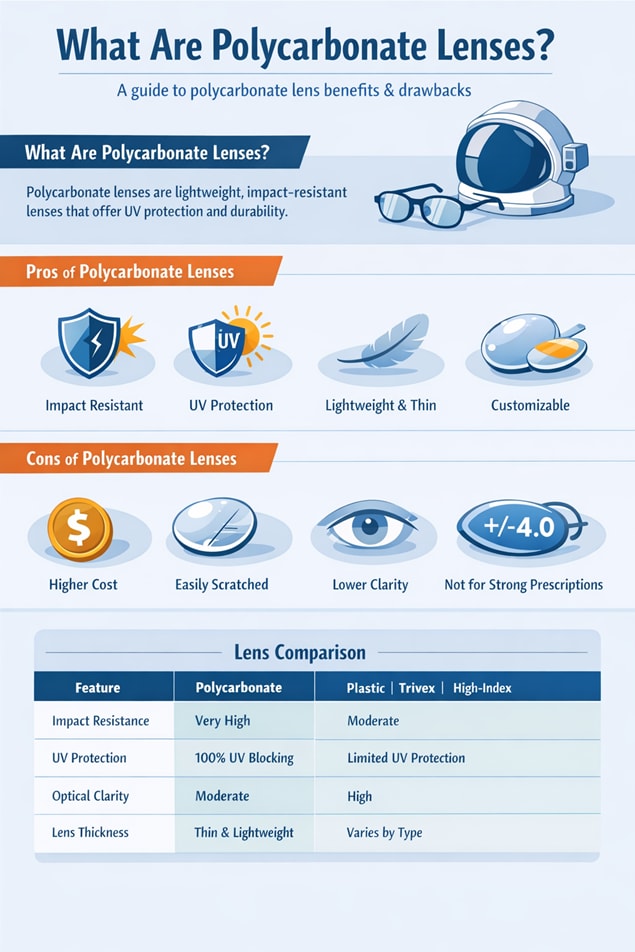
Polycarbonate lenses are lightweight, durable, and impact-resistant eyewear lenses that block nearly 100% of UV rays. Ideal for children, athletes, and safety eyewear, they combine visual correction with protection, though they may scratch easily and are less optically clear than other lens materials.
Advantages of Polycarbonate Lenses
Polycarbonate lenses (also called "poly") are highly durable and versatile. Here are their key benefits:
- 🛡 Impact Resistant: Up to 10× more resistant than standard plastic lenses; used in safety glasses and bulletproof applications.
- 🌞 UV Protection: Blocks nearly 100% of harmful UV rays, preventing long-term eye damage.
- ⚖ Lightweight & Thin: Comfortable for daily wear without compromising vision correction.
- 🎨 Customizable: Anti-glare, blue light, and scratch-resistant coatings can be applied.
Disadvantages of Polycarbonate Lenses
Despite their popularity, poly lenses have limitations:
- Cost: Up to twice as expensive as standard plastic lenses.
- Scratch-Prone: Easily scratched; scratch-resistant coatings increase price.
- Lower Optical Clarity: May show chromatic aberrations around lights (rainbow effect).
- Prescription Limitations: Less suitable for strong prescriptions (>±4.0) or severe astigmatism.
Comparing Lens Materials
Plastic vs Polycarbonate
| Feature | Plastic Lenses | Polycarbonate Lenses |
|---|---|---|
| Optical Clarity | Higher (Abbe value nearly double) | Lower |
| UV Protection | ❌ Limited | ✅ Blocks nearly 100% |
| Durability | Moderate | High impact resistance |
| Weight | Heavier | Lightweight |
High-Index vs Polycarbonate
High-index lenses are thinner for high prescriptions but heavier.
Polycarbonate is more impact-resistant and lightweight, suitable for sports and children.
Trivex vs Polycarbonate
Trivex lenses are lighter (+10% lighter) and have higher clarity (better Abbe value).
Polycarbonate is thinner, better for higher prescriptions, and more affordable.
Glass vs Polycarbonate
Glass lenses offer highest clarity and scratch resistance.
Polycarbonate lenses are lighter, safer, and protective, ideal for active users.
You may also like
Who Should Choose Polycarbonate Lenses?
Polycarbonate lenses are ideal for:
- Children and teenagers (lightweight and safe)
- Athletes and outdoor enthusiasts
- Field workers and industrial settings
- People with low vision in one eye
Practical Tips for Using Polycarbonate Lenses
- Always use a scratch-resistant coating.
- Clean with microfiber cloth and lens-safe solution.
- Avoid extreme temperatures to prevent warping.
- Pair with frames that complement lightweight lenses for comfort.
Frequently Asked Questions (FAQ)
Are polycarbonate lenses better than plastic lenses?
Yes, polycarbonate is more impact-resistant, lightweight, and blocks UV rays, while plastic lenses excel in clarity and are less expensive.
Can polycarbonate lenses be used for high prescriptions?
Yes, up to moderate prescriptions (±4.0). For stronger prescriptions, high-index lenses may be preferable.
How do polycarbonate lenses compare to Trivex?
Trivex offers slightly higher clarity and is lighter, but polycarbonate is thinner, more affordable, and extremely durable.