Choose from our wide range of
frames and lenses














Back to the articles
Eye Colors Explained: What Is the Rarest Eye Color and Why Eyes Are Different Colors
Guides & How To

The rarest natural eye colors are red and violet, typically associated with albinism.
Among common eye colors, green is the rarest worldwide, appearing in about 2% of the global population.
Eye color depends mainly on genetics and melanin levels, which influence how light interacts with the iris.
Eye Color Distribution Around the World
Eye color varies significantly depending on genetics, ancestry, and geographic origin.
While brown eyes dominate globally, lighter eye colors are more common in certain regions such as Northern Europe.
Global Eye Color Distribution
| Eye Color | Estimated Global Population | Key Regions |
|---|---|---|
| Brown | 70–79% | Africa, Asia, Middle East |
| Blue | 8–10% | Northern Europe, North America |
| Hazel | ~5% | Europe, Americas |
| Amber | ~5% | Scattered globally |
| Gray | ~3% | Eastern & Northern Europe |
| Green | ~2% | Northern & Central Europe |
What Is the Rarest Eye Color?
The rarest eye colors are red and violet, although they occur almost exclusively in people with albinism, a genetic condition that affects melanin production.
When melanin is absent in the iris, light reflects off blood vessels inside the eye, creating the appearance of red or violet eyes.
These eye colors are extremely rare and represent a tiny fraction of the global population.
Key Facts About Red or Violet Eyes
- Usually linked to ocular albinism
- Caused by very low or absent melanin
- Blood vessels become visible through the iris
- May increase light sensitivity
Research published in ophthalmology journals suggests that individuals with albinism may experience increased photophobia and vision challenges, making protective eyewear and UV protection especially important.
Rarest Common Eye Colors
While red or violet eyes are medically rare, several eye colors are uncommon but occur naturally in healthy populations.
These include green, gray, hazel, and amber eyes.
Green Eyes (The Rarest Common Eye Color)
Green eyes occur in about 2% of the global population, making them the rarest naturally occurring eye color among healthy individuals.
In the United States, roughly 9% of people have green eyes.
Green eye color appears due to moderate melanin levels combined with light scattering inside the iris, a phenomenon known as the Rayleigh scattering effect.
Green eyes are most common in:
- Ireland
- Scotland
- Iceland
- Northern and Central Europe
Style Tip:Anti-reflective lenses help make eye color more visible by reducing glare.
Gray Eyes
Gray eyes appear in roughly 3% of the global population.
Scientists believe gray eyes develop similarly to blue eyes but contain slightly more melanin in the front layer of the iris, which changes how light scatters.
Gray eyes can appear in multiple shades:
- Gray-blue
- Gray-green
- Dark charcoal
- Silver gray
Lighting, clothing, and makeup can make gray eyes appear to change color.
Hazel Eyes
Hazel eyes combine green, brown, and sometimes gold tones in the iris.
About:
- 18% of Americans
- 5% of the global population
have hazel eyes.
Unlike green eyes, hazel eyes contain relatively high melanin levels, but the pigment is distributed unevenly around the iris.
Hazel eyes often show radial color streaks near the pupil.
Style Tip
Frames in green, tortoise, gold, or brown tones highlight hazel eye color. Find here the best glasses frames for your face shape.
Amber Eyes
Amber eyes are often mistaken for hazel but have a more uniform golden or copper tone.
Only about 5% of people worldwide have amber eyes.
The color comes from a melanin pigment called lipochrome, which creates a warm gold or orange hue.
Amber eyes are more commonly seen in animals such as:
- wolves
- owls
- cats
- eagles
You may also like
Most Common Eye Colors
Globally, darker eye colors dominate due to higher melanin levels.
Brown Eyes
Brown eyes are the most common eye color worldwide.
About:
- 45% of Americans
- up to 70–79% of the global population
have brown eyes.
Brown eyes range from:
- light honey brown
- golden brown
- dark chocolate brown
Although some irises appear black, true black eyes do not exist; they are simply very dark brown.
Higher melanin levels may provide some natural protection against:
- UV radiation
- cataracts
Blue Eyes
Blue eyes occur in about:
- 27% of Americans
- 8–10% globally
A widely cited genetic study suggests that all people with blue eyes share a common ancestor who lived approximately 10,000 years ago in Europe.
Blue eyes contain very little melanin, which means light scatters within the iris instead of being absorbed.
Because of lower pigmentation, people with light-colored eyes may be more sensitive to sunlight and should prioritize UV-protective sunglasses.
What Determines Eye Color?
Two primary biological factors determine eye color:
Genetics
Eye color inheritance is more complex than previously believed.
Earlier theories suggested a single gene determined eye color, but modern genetic research shows that up to 16 genes contribute to eye pigmentation.
This explains why:
- two brown-eyed parents can have a blue-eyed child
- siblings may have different eye colors
Melanin Levels
Melanin is the pigment responsible for skin, hair, and eye color.
The amount and distribution of melanin in the iris determine whether eyes appear:
- dark brown
- hazel
- green
- blue
General rule:
- More melanin → darker eyes
- Less melanin → lighter eyes
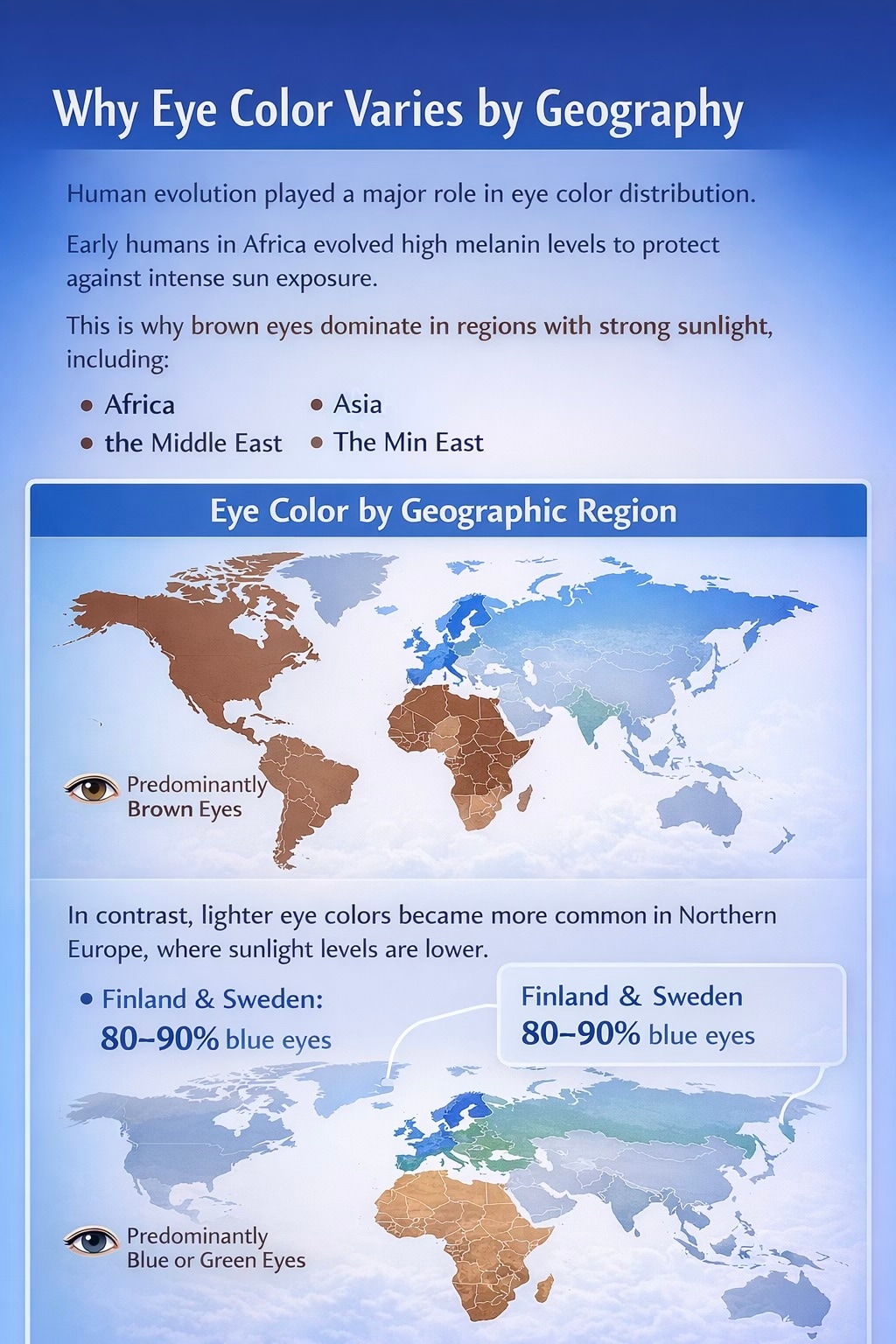
Why Eye Color Varies by Geography
Human evolution played a major role in eye color distribution.
Early humans in Africa evolved high melanin levels to protect against intense sun exposure.
This is why brown eyes dominate in regions with strong sunlight, including:
- Africa
- Asia
- the Middle East
In contrast, lighter eye colors became more common in Northern Europe, where sunlight levels are lower.
For example:
- Finland and Sweden: 80–90% blue eyes
- United Kingdom and Ireland: 50%+ blue eyes
How to Protect and Enhance Your Eye Color
No matter your eye color, proper eye care helps maintain healthy vision.
Practical Tips
- Wear UV-protectivesunglasses outdoors
- Choose anti-reflective lenses to make your eyes more visible
- Select frame colors that complement your natural eye color
- Schedule regular eye exams→ How often should you get an eye exam?
FAQ: Eye Color
Can eye color change over time?
Yes. Eye color can appear to change slightly due to lighting, aging, or health conditions, but permanent changes are rare in adulthood.
Are green eyes genetic?
Yes. Green eyes are influenced by multiple genes that regulate melanin production and iris structure.
Why do some babies’ eye colors change?
Many babies are born with blue or gray eyes because melanin production has not fully developed yet.
Eye color may change during the first year of life.