Choose from our wide range of
frames and lenses














Glasses were invented in Italy between 1268 and 1300, when artisans first combined two convex lenses into a wearable frame to correct vision. Earlier magnifying devices existed, but this moment marks the birth of true eyeglasses.
Why This Question Matters Today
Understanding when glasses were invented helps explain how modern eyewear evolved from simple visual aids into precise medical devices used by millions of Americans every day.
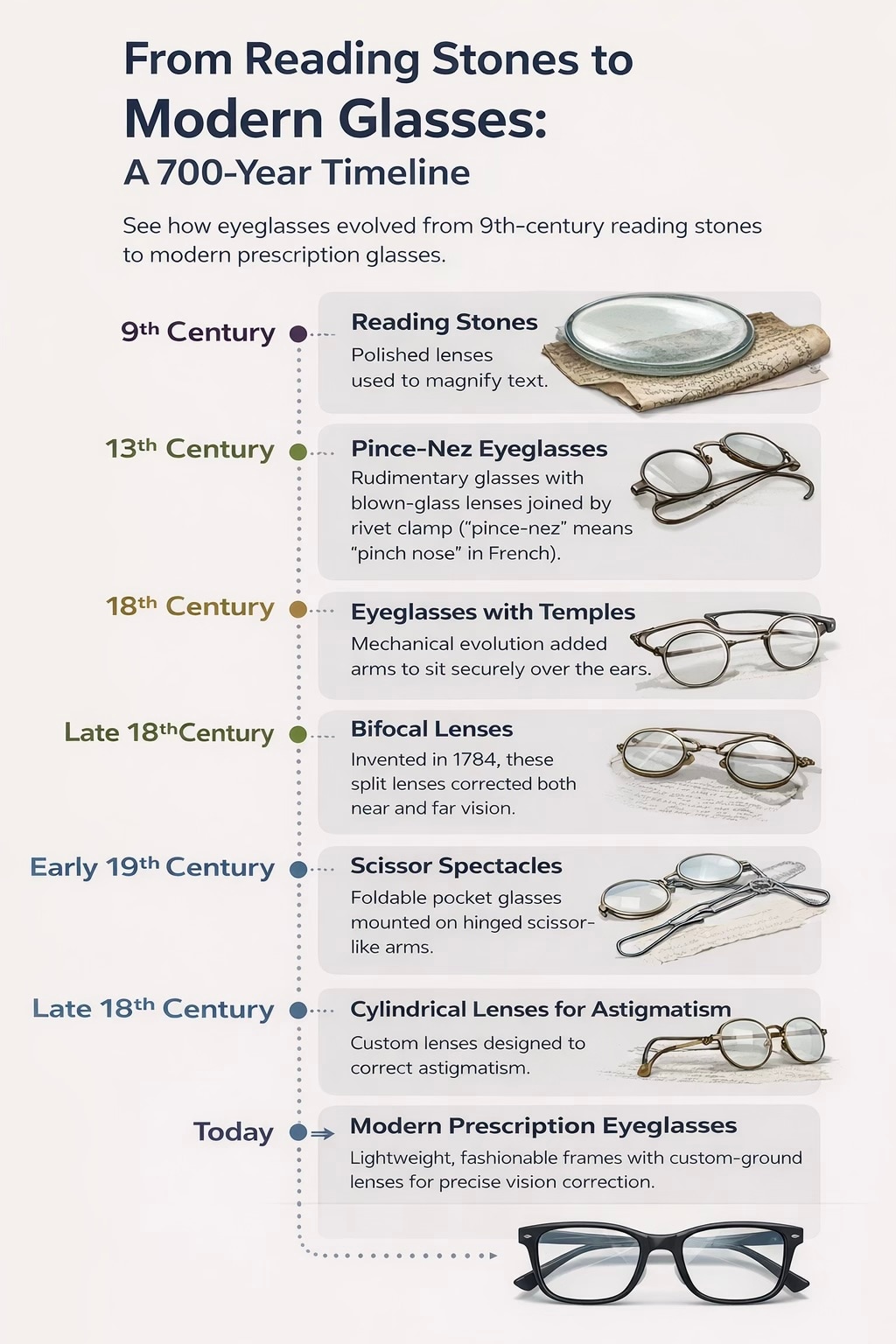
The First Pair of Glasses in History
Early Magnification Before Eyeglasses
Long before wearable eyewear, people relied on basic optical tools:
- Ancient Rome: Glass spheres used to magnify text
- 9th century: Abbas Ibn Firnas developed polished reading stones
These tools improved vision but were not wearable, so they are not considered eyeglasses.
When Did People Start Wearing Glasses?
People began wearing glasses in the late 13th century in northern Italy. Artisans mounted two convex lenses in frames made of wood, leather, or horn and balanced them on the nose.
This innovation created the first pair of glasses designed to correct vision handsfree.
When Were Eyeglasses Invented?
Italy (1268–1300): The Accepted Origin
Most historians agree that eyeglasses were invented in Italy between 1268 and 1300. These early spectacles:
- Corrected farsightedness
- Used glassblown convex lenses
- Were connected by a rivet or hinge
This answers related queries such as:
- when were eyeglasses invented
- when was glasses invented
- when were eyeglasses made
Visual Proof From Art and Manuscripts
Paintings by Tommaso da Modena (1352) depict monks using early pincenez style glasses, providing strong historical evidence.
How Were Glasses Invented?
Eyeglasses emerged through trial-and-error craftsmanship, not a single invention moment.
StepbyStep Development
- 1. Observation that convex glass magnified text
- 2. Handgrinding lenses with different thicknesses
- 3. Joining two lenses for binocular vision
- 4. Adding frames to stabilize lenses on the nose
Evolution of Eyeglass Design
Renaissance to 1700s
Eyeglasses spread across Europe and became symbols of education and status. Key developments included:
- Improved lens accuracy
- Stronger materials
- Introduction of temple arms over the ears
Handsfree glasses dramatically increased adoption.
You may also like
18th–19th Century Breakthroughs
| Innovation | Impact |
|---|---|
| Bifocals (Benjamin Franklin) | One pair for near and far vision |
| Cylindrical lenses | Correction for astigmatism |
| Industrial production | Affordable eyewear for the public |
Modern Glasses and Mass Adoption
20th Century to Today
The invention of plastics transformed eyewear:
- Lighter frames
- Fashionforward designs
- Durable lenses
Sunglasses, first documented in 12thcentury China for nonprotective use, became mainstream for UV protection in the 20th century.
Internal Vision Care Connections
To better understand how eyewear works today, explore these related guides:
Practical Takeaways for Today’s Wearers
- Modern glasses are the result of 700+ years of innovation
- Accurate prescriptions depend on precise measurements
- Frame design affects comfort, vision, and eye health
FAQ – People Also Ask
When was the first pair of glasses invented?
The first wearable eyeglasses appeared in Italy between 1268 and 1300.
Who invented glasses?
There is no single inventor; eyeglasses evolved through Italian glassmakers and artisans.
How were eyeglasses invented?
They developed gradually by combining magnifying lenses with wearable frames.
Expert Sources and Historical References
This article is based on consolidated findings from:
- Medieval Italian optical manuscripts
- Renaissance art analysis
- Vision science historical reviews