Choose from our wide range of
frames and lenses









Back to the articles
Snellen Eye Chart: How to Read It and What 20/20 Vision Really Means
Eye Wellness
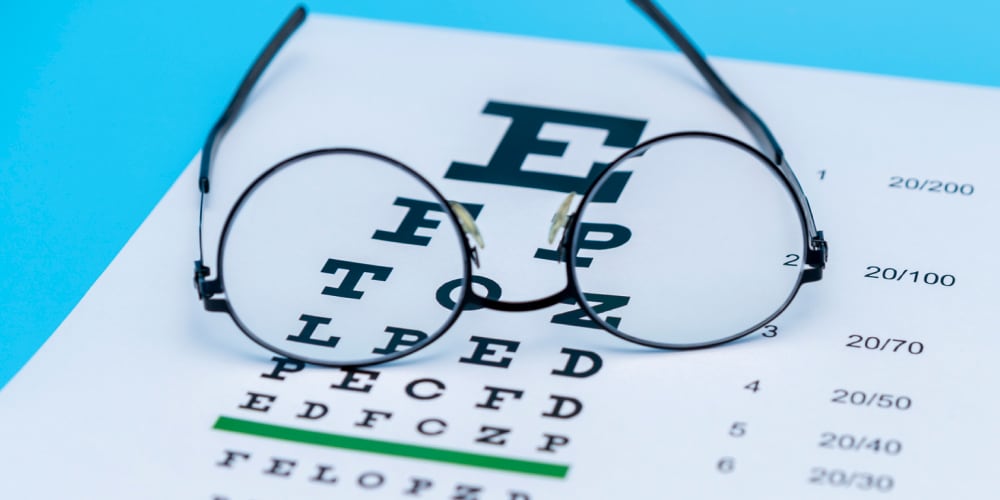
The Snellen eye chart measures visual acuity using rows of letters that decrease in size. 20/20 vision means you can read at 20 feet what a person with normal vision reads at 20 feet. It is commonly used in DMV, school, and clinical vision tests.
The Snellen eye chart has been the standard tool for measuring distance vision for more than 160 years. Whether you're taking a driver's license vision screening, visiting your eye doctor, or checking your eyesight at school, chances are you'll read the same familiar chart with rows of letters that become smaller on each line.
While the chart measures how clearly you see at a distance, it does not diagnose eye diseases or replace a comprehensive eye exam.
This article was reviewed by the Glasses.com editorial team against verified sources including the American Academy of Ophthalmology (AAO), the American Optometric Association (AOA), and peer-reviewed clinical literature.
What Is a Snellen Eye Chart?
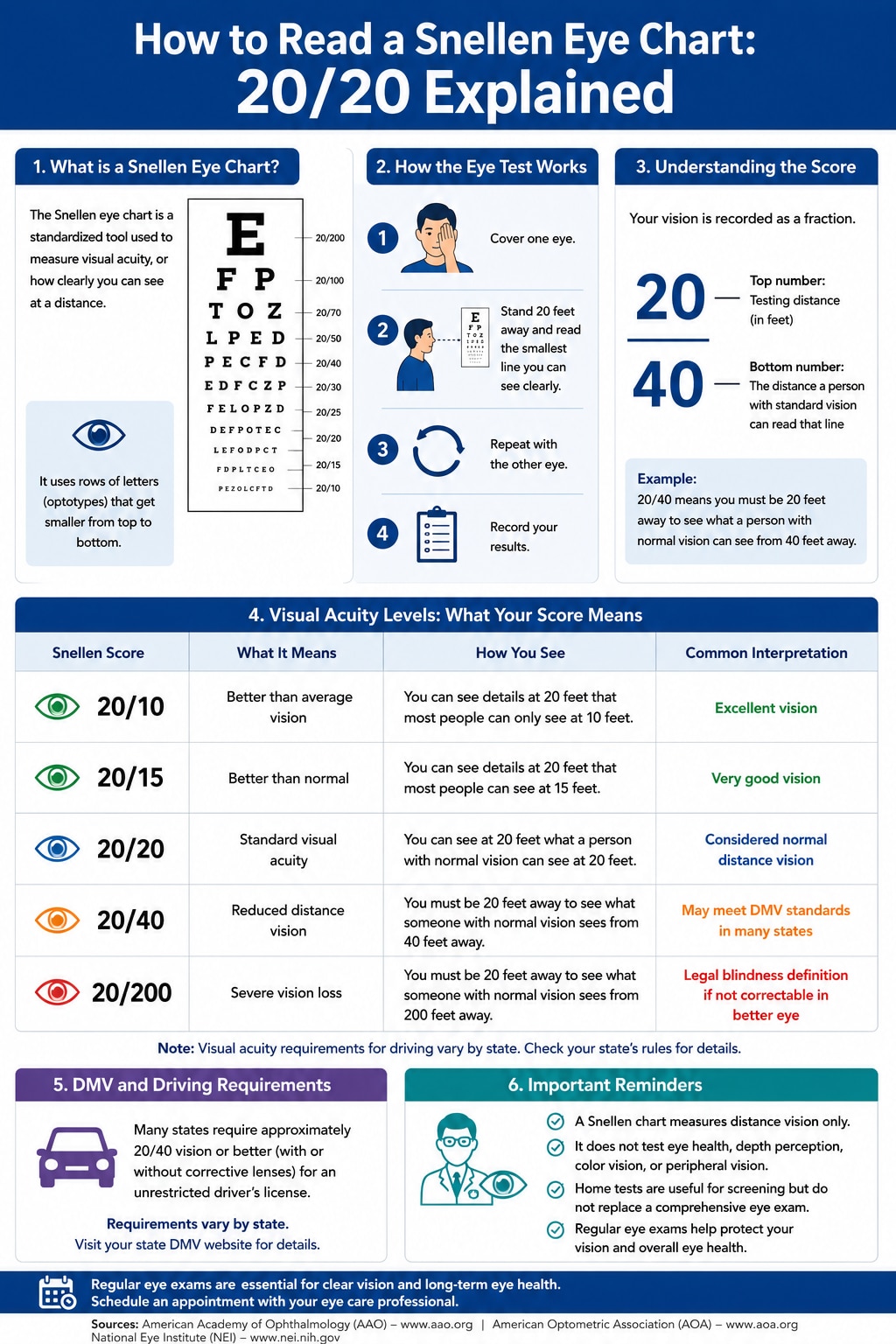
A Snellen eye chart is a standardized vision test that measures visual acuity, or how clearly you can see objects at a distance.
The chart includes:
- 11 rows of uppercase letters called optotypes
- Large letters at the top that gradually decrease in size
- Carefully selected Snellen chart letters such as C, D, E, F, L, O, P, T, and Z
These letters were chosen because they are similar in shape and cannot be easily guessed when blurry. Letters with unique features, such as "Q," are generally excluded because they may be recognized even when they are not clearly visible.
The chart was developed in 1862 by Dutch ophthalmologist Herman Snellen and remains one of the most widely used methods for testing distance vision today.
You may also like
How Is the Snellen Eye Chart Used?
During a standard eye exam, you'll stand or sit 20 feet from the chart (or the optical equivalent using mirrors or digital displays).
Your eye care professional will ask you to:
- Cover one eye.
- Read the smallest line you can see clearly.
- Repeat the test with the other eye.
- Read with and without your glasses or contact lenses, if needed.
A home printable Snellen chart can provide a basic vision screening, but it cannot replace a comprehensive eye exam that checks your eye health and prescription.
Related resources:
How to Read a Snellen Eye Chart
The results are written as a fraction, such as 20/20, 20/40, or 20/200.
- The top number (20) is the testing distance in feet.
- The bottom number represents the distance at which someone with standard vision can read the same line.
For example, if your vision is 20/40, you must stand 20 feet away to read what someone with typical vision can read from 40 feet away.
What do common vision scores mean?
Snellen Score
What It Means
Typical Interpretation
20/10
Better than average vision
Excellent distance vision
20/15
Better than normal
Common in healthy young adults
20/20
Standard visual acuity
Considered normal distance vision
20/40
Reduced distance vision
May meet DMV standards in many states but could require correction
20/200
Severe vision loss
May meet the definition of legal blindness if not correctable in the better eye
Vision requirements for driving vary by state, so always check your state's licensing rules.
What Does 20/20 Vision Mean?
20/20 vision means you can clearly read a line of letters at 20 feet that a person with standard visual acuity can also read at 20 feet.
It does not necessarily mean your eyesight is perfect.
A Snellen test measures only one part of vision. It does not evaluate:
- Peripheral vision
- Eye coordination
- Depth perception
- Color vision
- Eye health
Someone with 20/20 vision may still need treatment for conditions such as glaucoma, cataracts, or macular degeneration.
What Does 20/40 Vision Mean?
20/40 vision means you must be 20 feet away to see what someone with standard vision can see from 40 feet away.
Many people with 20/40 vision notice:
- Difficulty reading distant road signs
- Blurry classroom presentations
- Trouble recognizing faces at a distance
Depending on your state, 20/40 vision or better—with or without corrective lenses—is often sufficient for an unrestricted driver's license.
If your vision is worse than expected, your eye doctor may recommend glasses, contact lenses, or additional testing. Shop prescription eyeglasses
Can You Test Your Vision at Home?
A printable Snellen chart can help you monitor changes in your distance vision between eye exams.
To get the most reliable results:
- Print the chart at full size.
- Measure exactly 20 feet from the chart.
- Test one eye at a time.
- Wear your usual glasses if you're checking your corrected vision.
- Record your results for future comparison.
If your vision suddenly changes, becomes blurry, or you notice flashes, floaters, double vision, or eye pain, schedule an eye exam promptly rather than relying on a home test.
Why Regular Eye Exams Matter
The Snellen eye chart measures visual acuity, but a comprehensive eye exam evaluates much more.
An eye care professional can also check for:
- Refractive errors
- Cataracts
- Glaucoma
- Diabetic eye disease
- Age-related macular degeneration
- Overall eye health
Regular eye exams help detect vision changes early, even before symptoms become noticeable.
Key Takeaways
- The Snellen eye chart measures distance visual acuity using standardized rows of letters.
- 20/20 vision means you see at 20 feet what a person with standard vision sees at 20 feet—it does not mean perfect eye health.
- 20/40 vision indicates reduced distance vision and may still meet many DMV driving requirements, depending on state regulations.
- A home Snellen test can be useful for screening but should never replace a comprehensive eye exam.
- Regular eye exams evaluate both your vision and the overall health of your eyes.
FAQ
What does 20/20 vision mean?
20/20 vision means you can read at 20 feet what a person with standard visual acuity can read at 20 feet. It measures distance clarity but does not assess overall eye health, peripheral vision, or color vision.
How do I read a Snellen eye chart?
Stand 20 feet from the chart, cover one eye, and read the smallest line you can see clearly. Repeat with the other eye. Your result is recorded as a fraction such as 20/20 or 20/40 based on the smallest line read accurately.
What vision is required for a driver's license?
Requirements vary by state. Many states allow an unrestricted driver's license with visual acuity of 20/40 or better, with or without corrective lenses. If your vision does not meet the standard, additional testing or restrictions may apply.