Choose from our wide range of
frames and lenses



Sunglasses date back to prehistoric Inuit people who used carved ivory snow goggles to reduce glare. Modern tinted sunglasses became popular in the 1930s when Sam Foster began selling them on the Atlantic City boardwalk.
Editorial review note: Reviewed for historical accuracy and updated with current historical and eye-health information. Claims about dates, inventors, brands, and product introductions should be checked during the editorial approval process before publication.
Who invented sunglasses?
There is no single person who invented sunglasses. The earliest known forms were protective snow goggles used by Indigenous peoples in Arctic regions thousands of years ago.
These goggles were made from materials such as bone, antler, wood, and other locally available materials. Narrow openings helped reduce the amount of bright reflected light reaching the eyes.
These early goggles were different from modern sunglasses. They were designed mainly to reduce glare and help protect against snow blindness, rather than to provide a tinted lens for everyday use.
That distinction helps explain why the answer to "when were sunglasses invented?" depends on what you mean by sunglasses. Protective eyewear is thousands of years old, while the commercial sunglasses familiar today emerged much later.
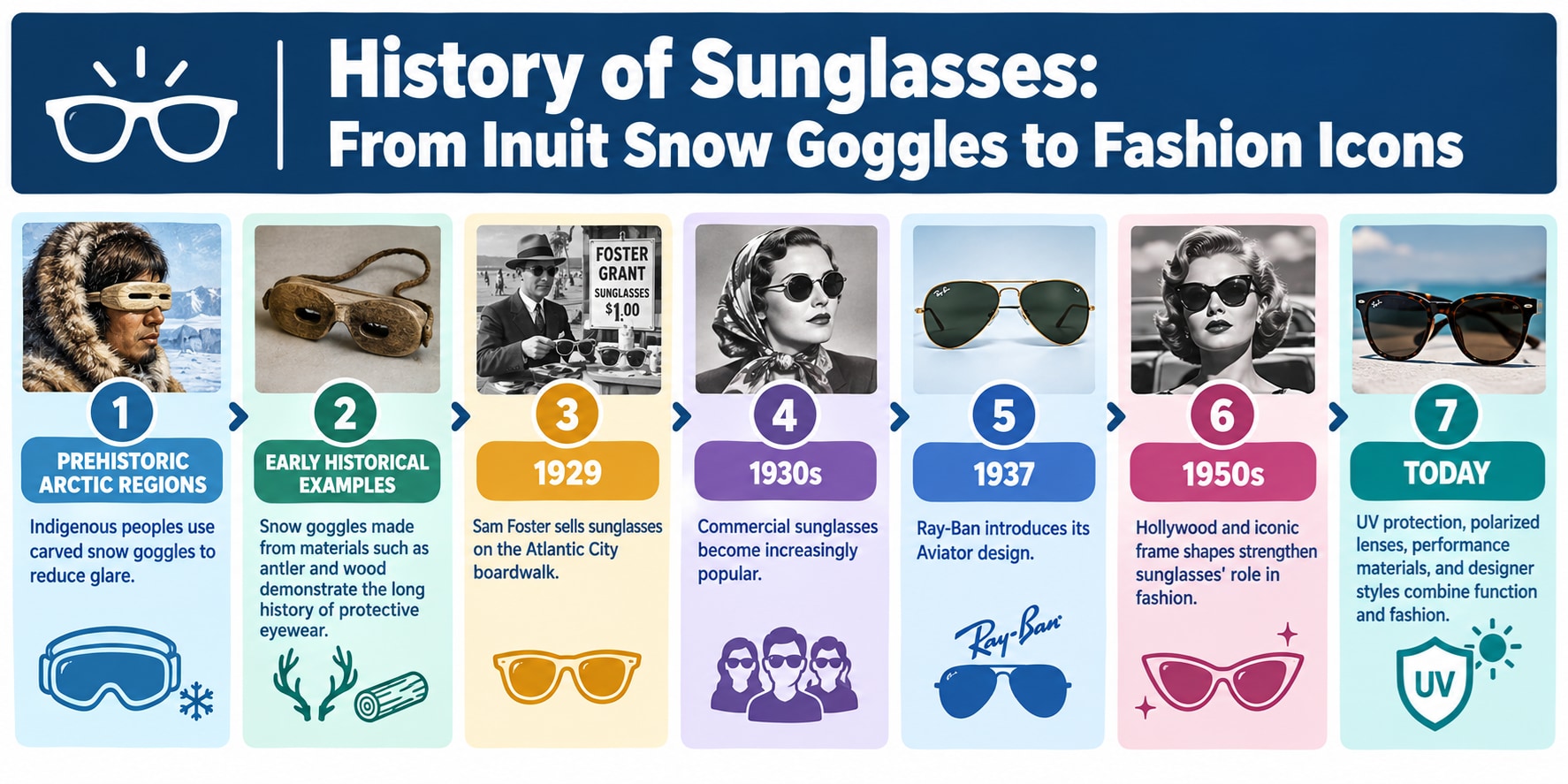
When did sunglasses become popular?
Sunglasses became popular as a consumer fashion item in the United States during the 1930s. In 1929, Sam Foster began selling sunglasses on the Atlantic City boardwalk through Foster Grant.
The timing mattered. Sunglasses were becoming easier to buy, less expensive, and increasingly associated with outdoor recreation and personal style. By the 1930s, they were no longer limited to specialized eye protection.
A simple timeline shows how sunglasses evolved:
Period
Development
Main purpose or influence
Prehistoric Arctic regions
Snow goggles
Reduce snow glare and protect against snow blindness
18th–19th centuries
Early protective eyewear
Glare and light management
1929
Sam Foster sells sunglasses
Commercial sunglasses enter the mass market
1930s
Sunglasses become more common
Sun protection and fashion
1937
Ray-Ban Aviator introduced
Aviation and military-inspired style
1950s
Wayfarer and Hollywood styles
Sunglasses become major fashion accessories
You may also like
How did sunglasses change from protection to fashion?
The history of sunglasses is closely tied to changes in technology, entertainment, travel, and popular culture.
In the 1930s, sunglasses gained a practical role for pilots and other people exposed to bright light. The Aviator style became one of the best-known examples of this period.
Hollywood then helped turn sunglasses into a style statement. During the 1950s and later decades, distinctive shapes became associated with actors, musicians, and other public figures.
Cat-eye, oversized, round, and other frame styles moved in and out of fashion. Sunglasses became an accessory that could express personal style as well as provide protection from bright sunlight.
The Wayfarer became another major milestone. Introduced in the 1950s, the design helped establish sunglasses as an accessory recognized as much for its shape and style as its function.
When were polarized sunglasses invented?
Polarized sunglasses emerged in the 1930s through the work of physicist Edwin H. Land. Land developed synthetic polarizing material that could be used in optical products.
Polarized lenses became an important development because they can reduce glare from reflective surfaces. This made them useful for activities such as driving, boating, skiing, and spending time near water.
Today, polarized sunglasses remain popular because they can make bright outdoor environments more comfortable and help reduce distracting reflected glare.
What were the first sunglasses made of?
The earliest protective eyewear was not made from modern glass or plastic lenses.
Arctic snow goggles were carved from materials such as wood, bone, antler, and whale baleen. Their narrow openings reduced the amount of light entering the eyes.
Modern sunglasses use manufactured lenses and frames. Depending on the design and intended use, materials can include glass, plastic, polycarbonate, and other engineered materials.
The materials have changed considerably, but the basic goal remains similar: helping people manage bright light while protecting their eyes.
Why are sunglasses important today?
Sunglasses have become a fashion accessory, but eye protection remains an important part of their purpose.
The American Optometric Association recommends sunglasses that block 100% of both UVA and UVB radiation. Good sunglasses can help reduce exposure to ultraviolet radiation while making bright outdoor conditions more comfortable.
When choosing sunglasses, look for:
- 100% UVA and UVB protection
- A comfortable, close-fitting frame
- Lenses without distortion or visible imperfections
- A lens color that works for your activity
- Impact-resistant materials for sports and other higher-risk activities
UV exposure can affect eye health over time. Intense short-term exposure can also cause photokeratitis, sometimes described as a sunburn of the eye.
For everyday protection and a range of styles, explore sunglasses.
How has eyewear evolved?
Sunglasses are only one part of the longer history of eyewear.
Eyeglasses developed primarily to correct vision, while sunglasses evolved around glare reduction, light management, UV protection, and style.
You can explore the broader story in when were glasses invented?.
The history of sunglasses shows how a practical solution can become an everyday fashion accessory. From carved Arctic snow goggles to polarized lenses and iconic designer frames, sunglasses have continued to change with technology and culture.
Key Takeaway
- The earliest known sunglasses-like eyewear includes Arctic snow goggles used by Indigenous peoples to reduce glare.
- There is no single inventor of sunglasses; modern sunglasses developed gradually from earlier forms of protective eyewear.
- Sam Foster helped bring commercial sunglasses to a mass U.S. market in 1929.
- Edwin H. Land helped develop commercially successful polarizing technology during the 1930s.
- Today, sunglasses combine UV protection, glare reduction, comfort, and fashion.
Frequently Asked Questions
Who invented sunglasses?
No single person invented sunglasses. Indigenous peoples in Arctic regions developed snow goggles thousands of years ago to reduce glare from snow. Modern commercial sunglasses emerged much later, with Sam Foster selling sunglasses on the Atlantic City boardwalk in 1929.
When did sunglasses become a fashion item?
Sunglasses became a major fashion item during the 20th century, particularly from the 1930s onward. Hollywood, popular culture, and iconic designs such as Aviators and Wayfarers helped establish sunglasses as both functional eyewear and a fashion accessory.
What were the first sunglasses made of?
The earliest sunglasses-like eyewear was made from natural materials such as wood, bone, antler, and whale baleen. Arctic snow goggles used narrow openings instead of modern lenses to reduce the amount of bright reflected light reaching the eyes.