Choose from our wide range of
frames and lenses










As of 2016, U.S. passport photos generally do not allow glasses. The U.S. Department of State requires photos without eyeglasses to reduce glare and simplify identity verification, with limited medical exceptions.
If you wear glasses every day, taking a passport photo can raise a simple question: Can you wear glasses in passport photos? For most U.S. passport applications, the answer is no.
The rule applies to eyeglasses, sunglasses, and tinted glasses. There is a limited medical exception when you cannot remove your glasses for medical reasons.
Editorial review: Reviewed for factual accuracy against current U.S. passport photo requirements. Requirements can change, so applicants should confirm the latest rules before submitting a photo.
Can You Wear Glasses for a U.S. Passport Photo?
No. For a standard U.S. passport photo, you must remove your glasses.
The current U.S. passport glasses policy requires applicants to take off eyeglasses, sunglasses, and tinted glasses before taking their passport photo. Glasses should not be left resting on your head, either.
This rule applies even if you wear prescription glasses every day. Unless you qualify for a medical exception, take your glasses off before the photo is taken.
Why No Glasses in Passport Photos?
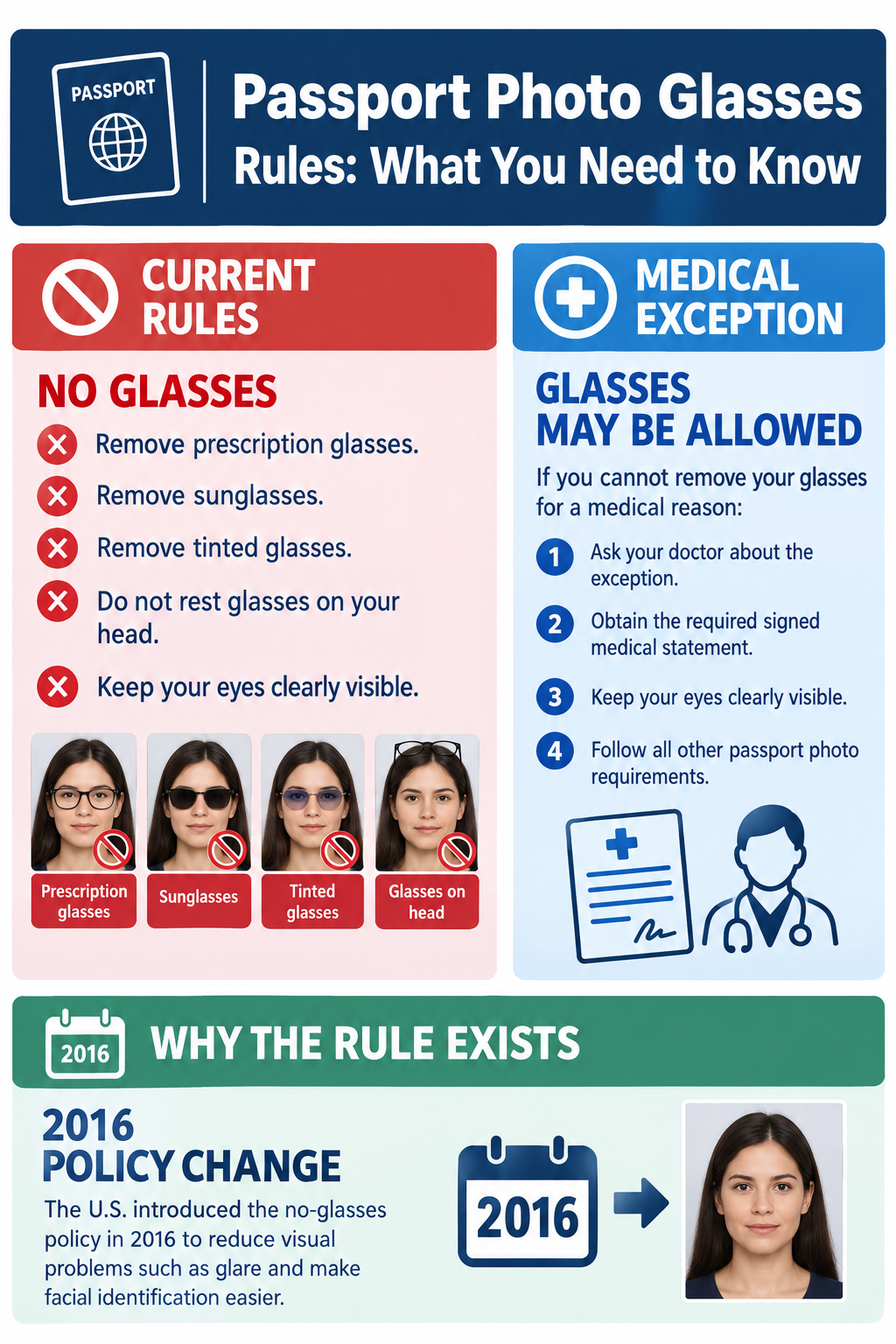
Glasses can create glare, reflections, shadows, or other visual effects that make the eyes and facial features harder to see.
The no-glasses policy helps provide a clear image of your face for identity checks. Removing glasses also avoids problems caused by frames or reflections covering important facial features.
For that reason, clear prescription glasses are generally not permitted in a standard U.S. passport photo.
What Are the Glasses in Passport Photo Rules?
The easiest way to remember the glasses in passport photo rules is:
- Remove eyeglasses before taking your U.S. passport photo.
- Remove sunglasses and tinted glasses, too.
- Do not place glasses on top of your head for the photo.
- If you cannot remove your glasses for a medical reason, follow the medical exception process.
- If glasses are allowed for a medical reason, your eyes must remain clearly visible.
- Frames, glare, shadows, or lens effects must not obscure your eyes.
If you need prescription eyewear before or after your trip, explore eyeglasses.
Are There Exceptions to the No-Glasses Passport Rule?
Yes. There is a limited medical exception to the no-glasses rule.
If you cannot remove your glasses for a medical reason, you may be able to wear them in your passport photo. The U.S. Department of State says applicants should include a signed note from their doctor with the application.
A medical need may include a situation where glasses are needed to protect your eyes after a recent eye procedure or surgery.
Simply needing prescription glasses to see clearly does not automatically mean you qualify for the exception.
What Happens If Glasses Are Allowed?
Even when a medical exception applies, your glasses must not prevent your eyes from being clearly visible.
Photo situation
U.S. passport photo rule
Prescription glasses
Remove them
Sunglasses
Remove them
Tinted glasses
Remove them
Medical reason glasses cannot be removed
Medical exception may apply
Signed doctor's note
Required for the medical exception
Frames covering the eyes
Not acceptable
Glare or reflection covering the eyes
Not acceptable
Shadows obscuring the eyes
Not acceptable
You may also like
Are Sunglasses Allowed in Passport Photos?
No. Sunglasses are not allowed in a standard U.S. passport photo.
Tinted glasses are also not allowed for a standard photo. If you have a medical reason that prevents you from removing your glasses, you should follow the medical exception process instead.
If you're taking your passport photo before a vacation, remember to remove your sunglasses before the picture is taken.
What Other Requirements Apply to a U.S. Passport Photo?
The glasses rule is only one part of the U.S. passport photo requirements.
Your photo should also meet these basic requirements:
- It must be in color.
- It must have been taken within the last six months.
- You should face the camera directly.
- Your eyes should be open and clearly visible.
- Your expression should be neutral or a natural smile.
- Your mouth should not be open.
- The background should be plain and white or off-white.
- The photo should not be digitally altered or filtered.
- A printed passport photo should measure 2 by 2 inches.
You should also avoid hats, headphones, and other items that obscure your face, except where specific medical or religious exceptions apply.
Before submitting your application, check the current passport photo requirements. A photo that does not meet the requirements can delay your passport application.
If you want to understand your prescription before ordering new eyewear, read glasses prescription.
Do Other Countries Allow Glasses in Passport Photos?
Yes. Passport photo rules vary by country.
Some countries allow prescription glasses when your eyes remain clearly visible and there is no glare, reflection, or shadow covering them.
This means you should not assume that the U.S. rule applies to every passport. If you are applying for a passport issued by another country, check that country's current requirements before taking your photo.
For a U.S. passport, however, the safest approach is simple: remove your glasses unless you have a qualifying medical exception.
What Should You Do Before Taking Your Passport Photo?
If you normally wear glasses, preparing for your passport photo is simple.
Use this quick checklist:
- Remove your prescription glasses.
- Remove sunglasses and tinted glasses.
- Make sure your eyes are clearly visible.
- Face the camera directly.
- Use a plain white or off-white background.
- Avoid filters and digital retouching.
- Make sure the photo was taken within the required time period.
- Check that the photo meets the required size and quality standards.
- If you cannot remove your glasses for a medical reason, ask your doctor about the required documentation.
Once your passport photo is done, you can get back to choosing the eyewear you actually want to wear on your trip.
Shop eyeglasses.
Key Takeaway
- U.S. passport photos require you to remove eyeglasses, sunglasses, and tinted glasses.
- The U.S. no-glasses policy has been in place since 2016.
- A medical exception may apply if you cannot remove your glasses for medical reasons.
- If glasses are allowed, they must not obscure your eyes.
- Passport photo rules vary by country, so always check the requirements for the passport you are applying for.
Frequently Asked Questions
Can You Wear Glasses for a U.S. Passport Photo?
No. Standard U.S. passport photos require you to remove eyeglasses, sunglasses, and tinted glasses. A limited medical exception may apply if you cannot remove your glasses for medical reasons.
Are There Exceptions to the No-Glasses Passport Rule?
Yes. A medical exception may apply if you cannot remove your glasses for medical reasons. You should include a signed note from your doctor with your application.
Do Other Countries Allow Glasses in Passport Photos?
Some countries allow prescription glasses if your eyes remain clearly visible and there is no glare, reflection, or shadow covering them. Rules vary by country.
Why Did the U.S. Stop Allowing Glasses in Passport Photos?
The U.S. introduced the no-glasses policy in 2016 to reduce problems caused by glare, reflections, and other visual effects and to make facial identification easier.
Can You Wear Contacts in a Passport Photo?
Yes. Contact lenses can generally be worn in a U.S. passport photo as long as they do not alter the natural appearance of your eyes or otherwise interfere with the photo requirements.
Can You Smile in a U.S. Passport Photo?
Yes. The current guidance allows a neutral facial expression or a natural smile. Your eyes should remain open and clearly visible, and you should avoid showing your teeth.
SOURCES
- New Eyeglasses Policy for Visa and Passport Photographs. U.S. Department of State — Bureau of Consular Affairs. September 2016.
- Passport Photos. U.S. Department of State — Bureau of Consular Affairs. June 2023.